What is GEO? A Beginner's Guide to Generative Engine Optimization
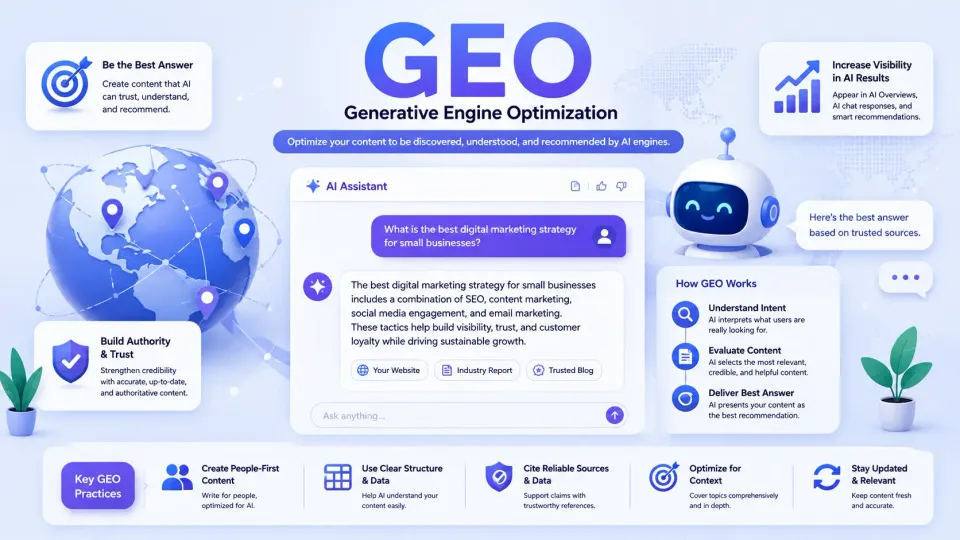
Table of Contents
Tap to expand
- Defining Generative Engine Optimization
- Why GEO Matters in 2026
- The Zero-Click Reality Has Intensified
- AI Platforms Are Becoming Primary Research Tools
- Content That AI Trusts Gets Amplified
- How GEO Differs from Traditional SEO
- Core Strategies for Effective GEO
- Write Clearly Structured, Factual Content
- Implement Comprehensive Schema Markup
- Build Topical Authority Through Content Depth
- Optimize for Quotability
- Ensure Broad Web Presence and Consistency
- Measuring GEO Performance
- Direct Measurement Methods
- Indirect Indicators
- Common GEO Mistakes to Avoid
- The Relationship Between GEO and Other Optimization Disciplines
- Getting Started with GEO
- Conclusion
- References
The way people search for information is undergoing a fundamental transformation. Instead of scrolling through a list of blue links on Google, millions of users now type their questions directly into AI-powered platforms like ChatGPT, Perplexity, Google Gemini, and Microsoft Copilot. These platforms do not simply list web pages. They synthesize information from multiple sources and deliver a single, coherent answer.
This shift has given rise to a new discipline called Generative Engine Optimization, or GEO. If SEO is about ranking on search engine results pages, GEO is about being the source that AI systems reference, cite, and recommend when generating their answers.
Defining Generative Engine Optimization
Generative Engine Optimization is the practice of structuring and optimizing your content so that generative AI systems are more likely to discover, understand, and cite it in their responses.
Traditional search engines rank pages and let users decide which one to click. Generative engines work differently. They consume vast amounts of content, determine which sources are most relevant and trustworthy, and then weave that information into a synthesized answer. Your content either makes it into that answer or it does not. There is no second-page placement in AI-generated results.
GEO focuses on three core outcomes:
- Being discovered — Ensuring AI crawlers and training pipelines can access and process your content.
- Being selected — Making your content authoritative and structured enough to be chosen as a reference source.
- Being cited — Earning an explicit mention or link within the AI-generated response so users know where the information originated.
Why GEO Matters in 2026
The adoption of AI-powered search has accelerated dramatically. Research from Gartner predicts that by the end of 2026, traditional search engine traffic could decline by as much as 25 percent as users migrate to AI-first search experiences. This represents a massive shift in how content is consumed online.
Here are the key reasons why GEO demands your attention right now:
The Zero-Click Reality Has Intensified
Even before generative AI, zero-click searches were already a growing concern. Users were getting answers directly from featured snippets and knowledge panels without ever visiting a website. Generative AI takes this even further by providing comprehensive, conversational answers that often eliminate the need to click through entirely.
If your content is not being referenced in these AI-generated answers, you are effectively invisible to a growing segment of your audience.
AI Platforms Are Becoming Primary Research Tools
A significant portion of users, particularly younger demographics, now turn to AI assistants as their first research tool rather than traditional search engines. Whether they are researching a purchase, learning a new concept, or comparing options, the AI assistant is often their starting point.
Content That AI Trusts Gets Amplified
When an AI system cites your content, it essentially endorses your authority on that topic. This creates a powerful feedback loop: being cited increases your perceived authority, which in turn makes AI systems more likely to cite you again in the future.
How GEO Differs from Traditional SEO
While GEO and SEO share some foundational principles, they differ significantly in their approach and priorities.
SEO optimizes for search engine algorithms. The goal is to rank as high as possible on a search results page. Success is measured by keyword positions, organic traffic, and click-through rates.
GEO optimizes for AI comprehension and citation. The goal is to have your content selected and referenced by AI systems when they generate responses. Success is measured by citation frequency, brand mentions in AI outputs, and referral traffic from AI platforms.
Here are the key differences:
- Content structure — SEO content is often optimized for scanning with short paragraphs and keyword placement. GEO content must be structured for machine comprehension with clear definitions, logical organization, and explicit factual statements.
- Authority signals — SEO relies heavily on backlinks. GEO values entity recognition, source reputation, and factual consistency across the web.
- Keyword strategy — SEO targets specific search queries. GEO focuses on topical coverage and ensuring your content answers the types of questions AI users ask.
- Success metrics — SEO tracks rankings and organic traffic. GEO tracks citations in AI outputs, brand mentions by AI systems, and referral traffic from AI platforms.
Core Strategies for Effective GEO
Implementing GEO requires a shift in how you think about content creation and optimization. Here are the strategies that make the biggest difference.
Write Clearly Structured, Factual Content
AI systems are remarkably good at extracting structured information. Content that is well-organized with clear headings, concise definitions, and explicit factual statements is far more likely to be cited.
Practical tips:
- Lead each section with a clear, definitive statement that directly answers a question.
- Use precise language and avoid ambiguity.
- Include specific data points, statistics, and concrete examples.
- Organize content in a logical hierarchy that moves from broad concepts to specific details.
Implement Comprehensive Schema Markup
Structured data helps AI systems understand the context and relationships within your content. Implementing schema markup goes beyond basic SEO benefits and directly improves how AI models interpret your pages.
Priority schema types for GEO:
- Article — Identifies your content as a piece of editorial content with a clear author and publication date.
- FAQPage — Marks up question-and-answer pairs that AI systems can directly extract.
- HowTo — Structures step-by-step instructions for easy AI consumption.
- Organization — Provides structured information about your brand or company.
- Person — Establishes author identity and credentials.
Build Topical Authority Through Content Depth
AI systems evaluate source authority not just by individual page quality but by the depth and breadth of coverage across your entire website. A site with comprehensive coverage of a topic is more likely to be treated as an authoritative source.
How to build topical authority:
- Create pillar content that covers major topics comprehensively.
- Develop supporting articles that address subtopics, related questions, and edge cases.
- Interlink your content to create clear topical clusters.
- Regularly update existing content to maintain accuracy and relevance.
Optimize for Quotability
AI systems often need concise, self-contained statements they can directly quote or paraphrase. Making your content easy to quote significantly increases your chances of being cited.
Techniques for quotable content:
- Write clear, standalone sentences that encapsulate key insights.
- Include expert opinions and original analysis.
- Provide unique frameworks, methodologies, or classifications.
- Offer data-backed conclusions that AI systems can reference with confidence.
Ensure Broad Web Presence and Consistency
AI models are trained on data from across the entire web, not just your own website. Your brand’s representation on third-party platforms, directories, publications, and social media all contribute to how AI systems perceive your authority.
- Maintain consistent information about your brand across all platforms.
- Get mentioned or featured on authoritative industry websites.
- Contribute expert insights to publications in your field.
- Ensure your brand information in knowledge bases and directories is accurate.
Measuring GEO Performance
Measuring the impact of GEO is more challenging than traditional SEO metrics, but there are practical approaches you can use.
Direct Measurement Methods
- Manual testing — Regularly query AI platforms with questions related to your industry and check whether your brand or content is cited.
- Referral traffic analysis — Monitor your analytics for traffic coming from AI platforms such as ChatGPT, Perplexity, or Google AI Overviews.
- Brand mention monitoring — Use tools to track when and where your brand is mentioned across AI-generated content.
Indirect Indicators
- Increases in branded search volume — If AI systems are mentioning your brand, users may subsequently search for you by name.
- Growth in direct traffic — Users who encounter your brand through AI may navigate directly to your website.
- Improved domain authority — Consistent citation by AI systems can indirectly boost your overall web authority.
Common GEO Mistakes to Avoid
As GEO is still a relatively new discipline, many practitioners make avoidable errors:
- Treating GEO as a replacement for SEO — GEO complements SEO; it does not replace it. You need both for comprehensive visibility.
- Ignoring content accuracy — AI systems are increasingly sophisticated at evaluating factual accuracy. Inaccurate content will be deprioritized.
- Neglecting structured data — Without proper schema markup, AI systems have to work harder to understand your content, reducing the likelihood of citation.
- Focusing only on your own website — Your broader web presence significantly influences how AI systems perceive your authority.
- Not monitoring AI outputs — If you never check how AI platforms represent your brand, you cannot identify problems or opportunities.
The Relationship Between GEO and Other Optimization Disciplines
GEO does not exist in isolation. It works alongside several related disciplines to create a comprehensive digital visibility strategy.
- SEO provides the foundation for discoverability and ensures your content is indexed and accessible.
- AIO (AI Optimization) focuses on how AI systems understand and represent your brand identity specifically.
- AEO (Answer Engine Optimization) targets featured snippets and direct answer placements.
- SXO (Search Experience Optimization) ensures that users who do visit your site have an excellent experience.
Together, these disciplines form a complete strategy for thriving in the modern search landscape.
Getting Started with GEO
If you are new to GEO, here is a practical roadmap to begin implementing it:
- Audit your existing content — Identify your most authoritative and comprehensive pieces of content.
- Test your AI visibility — Query major AI platforms with questions related to your expertise and observe the results.
- Optimize your best content first — Apply GEO principles to your strongest existing content before creating new material.
- Implement structured data — Add comprehensive schema markup to your key pages.
- Monitor and iterate — Regularly check AI outputs and refine your approach based on what you observe.
Conclusion
Generative Engine Optimization represents a fundamental shift in how we think about online visibility. As AI-powered search continues to grow, the brands that proactively optimize for AI citation will gain a significant competitive advantage over those that rely exclusively on traditional SEO.
The good news is that many GEO best practices align with creating genuinely valuable, well-structured, and authoritative content. By focusing on clarity, accuracy, and depth, you position your content to perform well in both traditional search results and AI-generated answers.
Want to dive deeper into related strategies? Explore our guides on SEO fundamentals and AIO: AI Optimization to build a complete modern search strategy.
References
- Aggarwal et al. (2023): GEO: Generative Engine Optimization — arXiv Paper
- Search Engine Land: What is Generative Engine Optimization
- Contentful: Generative Engine Optimization
- AdsMurai: What is GEO
- Signal AI: GEO and Reputation Management
- HubSpot: How to Optimize for AI Search Engines
- Gartner: Predicts 2025 — Search Marketing

Related Posts
What is AIO? The Ultimate AI Optimization Strategy
Learn what AIO (AI Optimization) is and how it works. Discover proven strategies to boost your brand visibility across AI platforms like ChatGPT and Gemini.
What is SEO? Complete Guide to Search Engine Optimization
Learn what SEO is and how it works. A complete beginner-friendly guide to Search Engine Optimization strategies for achieving higher rankings in 2026.
SEO, GEO, AIO, AEO, and SXO Explained for 2026
A practical and modern guide to understanding SEO, GEO, AIO, AEO, and SXO, and how they shape search, AI visibility, and conversions.