What is AIO? The Ultimate AI Optimization Strategy
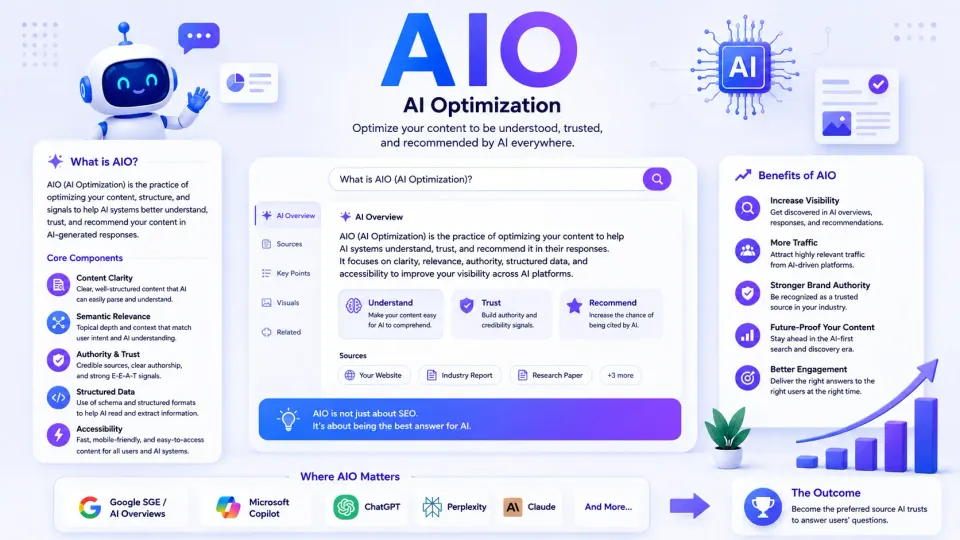
Table of Contents
Tap to expand
- Understanding AI Optimization
- Why AIO is Critical in 2026
- AI Is Becoming the Default Discovery Channel
- AI Decisions Happen Before Users See Results
- Brand Perception in AI Is Difficult to Correct
- AI Recommendations Carry Implicit Trust
- How AIO Differs from SEO and GEO
- The Core Pillars of AI Optimization
- Entity Establishment and Management
- Content Authority and Depth
- Cross-Platform Brand Consistency
- Reputation and Trust Signals
- Technical Accessibility
- Practical AIO Implementation Strategy
- Phase 1: Audit Your Current AI Presence
- Phase 2: Establish Your Entity Foundation
- Phase 3: Create Authoritative Content
- Phase 4: Expand Your Digital Footprint
- Phase 5: Monitor, Measure, and Iterate
- Measuring AIO Success
- Primary Metrics
- Secondary Indicators
- Common AIO Pitfalls
- The Future of AI Optimization
- Conclusion
- References
Artificial Intelligence is no longer just a tool that marketers use behind the scenes. It has become a primary channel through which consumers discover, evaluate, and choose brands. Every time someone asks ChatGPT for a product recommendation, queries Perplexity for a comparison, or receives a suggestion from Google’s AI Overview, an AI system is making decisions about which brands to mention and which to ignore.
AI Optimization, or AIO, is the strategic discipline of ensuring that AI systems accurately recognize, understand, and favorably represent your brand across these platforms. While SEO focuses on search engine rankings and GEO focuses on generative AI citations, AIO takes a broader view by addressing how your entire brand identity is perceived and processed by artificial intelligence.
Understanding AI Optimization
At its core, AIO is about controlling your brand’s narrative in the age of AI. When a user asks an AI assistant a question like “What is the best project management tool for remote teams?” the AI does not simply pull a ranked list from Google. It synthesizes information from countless sources, evaluates brand authority across multiple signals, and generates a response that reflects its understanding of the landscape.
AIO ensures that when AI systems process information about your brand, they arrive at an accurate and favorable understanding. This involves three fundamental objectives:
- Recognition — AI systems should know your brand exists and understand what you offer.
- Accuracy — The information AI systems have about your brand should be factually correct and up to date.
- Preference — When relevant queries arise, AI systems should consider your brand authoritative enough to mention and recommend.
Why AIO is Critical in 2026
The importance of AIO has grown exponentially as AI integration into daily life has accelerated. Here is what is driving this urgency.
AI Is Becoming the Default Discovery Channel
A growing number of consumers now begin their research with an AI assistant rather than a traditional search engine. This is especially pronounced among younger demographics and in professional contexts where efficiency matters. When someone asks an AI for recommendations, your brand is either in the answer or it is not. There is no organic listing to scroll down to.
AI Decisions Happen Before Users See Results
One of the most significant differences between traditional search and AI-powered discovery is that the curation happens before the user sees anything. In traditional search, users see a full page of results and choose which ones to explore. In AI-generated responses, the AI has already decided which brands are relevant. If your brand is not part of that decision, you have no opportunity to compete for the user’s attention.
Brand Perception in AI Is Difficult to Correct
AI models are trained on vast datasets and their understanding of your brand is shaped by everything available about you online. If inaccurate information exists across the web, AI systems may propagate those inaccuracies. Proactively managing your AI presence is far easier than trying to correct misconceptions after they have been embedded in AI training data.
AI Recommendations Carry Implicit Trust
When an AI assistant recommends a product or service, users tend to treat it with a high degree of trust. This is fundamentally different from seeing an ad or even a top-ranked search result. An AI recommendation feels like personalized advice from a knowledgeable assistant, making it incredibly influential in purchase decisions.
How AIO Differs from SEO and GEO
Understanding where AIO sits relative to other optimization disciplines is essential for building a coherent strategy.
SEO answers the question: Can people find my website on search engines?
GEO answers the question: Will AI systems cite my content in their generated answers?
AIO answers the question: Do AI systems understand my brand correctly and consider it authoritative?
While SEO and GEO focus primarily on content and its discoverability, AIO takes a holistic approach that encompasses your entire digital footprint. It considers how AI systems perceive your brand based on everything they can learn about you from across the web.
Here is how they compare across key dimensions:
- Scope — SEO focuses on your website. GEO focuses on your content. AIO focuses on your entire brand presence.
- Primary goal — SEO aims for rankings. GEO aims for citations. AIO aims for accurate brand understanding.
- Key tactics — SEO uses keyword optimization and link building. GEO uses structured content and schema. AIO uses brand consistency, entity management, and multi-platform presence.
- Measurement — SEO tracks keyword positions. GEO tracks AI citations. AIO tracks brand accuracy and mention quality across AI platforms.
The Core Pillars of AI Optimization
Effective AIO is built on several interconnected pillars that work together to establish and maintain your brand’s presence in AI systems.
Entity Establishment and Management
In the context of AI, an entity is a clearly defined concept that AI systems can recognize and associate with specific attributes. Your brand needs to exist as a well-defined entity in the knowledge graphs and training data that AI systems rely on.
How to establish your brand entity:
- Ensure your brand has a comprehensive and accurate Wikipedia page or Wikidata entry if eligible.
- Maintain detailed and consistent business profiles across Google Business Profile, LinkedIn, Crunchbase, and industry-specific directories.
- Use consistent naming conventions, descriptions, and categorizations everywhere your brand appears online.
- Implement Organization schema markup on your website with complete and accurate information.
Content Authority and Depth
AI systems evaluate the quality and depth of content associated with your brand to determine how authoritative you are on specific topics. Superficial content signals low expertise, while comprehensive, well-researched material signals genuine authority.
How to build content authority for AIO:
- Publish in-depth, expert-level content that covers your core topics thoroughly.
- Include original research, data, case studies, and unique insights that cannot be found elsewhere.
- Maintain a consistent publishing cadence that demonstrates ongoing engagement with your field.
- Ensure all content is factually accurate and regularly updated to reflect current information.
Cross-Platform Brand Consistency
AI models gather information about your brand from every corner of the internet. Inconsistencies between what your website says, what third-party sites report, and what social media profiles indicate can confuse AI systems and reduce their confidence in your brand.
How to maintain consistency:
- Audit your brand information across all platforms and correct any discrepancies.
- Use identical brand descriptions, value propositions, and key messages across all channels.
- Ensure contact information, leadership details, and company facts are uniform everywhere.
- Monitor third-party mentions for accuracy and request corrections when necessary.
Reputation and Trust Signals
AI systems do not just look at what you say about yourself. They evaluate what others say about you. Reviews, press mentions, expert endorsements, and industry recognition all contribute to how AI systems assess your brand’s trustworthiness.
How to strengthen trust signals:
- Actively cultivate positive reviews on relevant platforms.
- Pursue press coverage and mentions in authoritative industry publications.
- Participate in recognized industry events, awards, and certifications.
- Engage with and respond to public feedback, demonstrating accountability and transparency.
Technical Accessibility
For AI systems to understand your brand, they must be able to access and process the information on your website. Technical barriers can prevent AI crawlers from gathering the data they need.
How to ensure technical accessibility:
- Verify that AI crawlers can access your important pages by checking your robots.txt configuration.
- Implement comprehensive structured data markup across your website.
- Ensure your website loads quickly and renders content without requiring complex JavaScript execution.
- Provide clear, machine-readable information through APIs, data feeds, and structured content.
Practical AIO Implementation Strategy
Implementing AIO effectively requires a systematic approach. Here is a step-by-step framework you can follow.
Phase 1: Audit Your Current AI Presence
Before optimizing, you need to understand how AI systems currently perceive your brand.
- Query multiple AI platforms with questions related to your industry and see if your brand appears.
- Ask AI systems directly about your brand and evaluate the accuracy of their responses.
- Identify any incorrect information or misconceptions that need to be addressed.
- Document which competitors are being mentioned in AI responses for your target queries.
Phase 2: Establish Your Entity Foundation
Ensure your brand is clearly defined and consistently represented across the web.
- Update all business profiles and directory listings with accurate, comprehensive information.
- Implement Organization and Brand schema markup on your website.
- Create or update your Wikipedia page or Wikidata entry if applicable.
- Ensure your About page contains clear, structured information about your brand, mission, and key offerings.
Phase 3: Create Authoritative Content
Develop content that positions your brand as the definitive authority in your space.
- Identify the core topics and questions that your target audience asks AI systems.
- Create comprehensive, expert-level content that addresses these topics thoroughly.
- Include original data, unique perspectives, and actionable insights.
- Structure content for easy extraction by AI systems using clear headings, definitions, and summaries.
Phase 4: Expand Your Digital Footprint
Increase your brand’s presence across platforms that AI systems use as data sources.
- Contribute expert content to industry publications and authoritative websites.
- Participate in podcasts, webinars, and interviews that generate transcripts and citations.
- Engage actively on professional platforms like LinkedIn where AI systems may gather professional authority signals.
- Build relationships with other authoritative voices in your industry for cross-referencing.
Phase 5: Monitor, Measure, and Iterate
AIO is an ongoing process that requires continuous monitoring and refinement.
- Regularly test how AI platforms respond to queries relevant to your brand.
- Track changes in AI-generated mentions over time.
- Monitor referral traffic from AI platforms in your analytics.
- Adjust your strategy based on observed changes in AI behavior and new platform developments.
Measuring AIO Success
Quantifying AIO performance requires a combination of direct observation and indirect metrics.
Primary Metrics
- AI mention frequency — How often your brand appears in AI-generated responses for relevant queries.
- AI accuracy rate — The percentage of AI-generated statements about your brand that are factually correct.
- AI sentiment analysis — Whether AI systems describe your brand positively, neutrally, or negatively.
- AI platform referral traffic — The volume and quality of traffic arriving from AI-powered platforms.
Secondary Indicators
- Branded search volume trends — Increases may indicate that AI mentions are driving awareness.
- Direct traffic growth — Users who discover your brand through AI may navigate directly to your website.
- Share of voice in AI responses — How your brand’s AI presence compares to competitors for key topics.
Common AIO Pitfalls
Avoid these frequent mistakes when implementing your AIO strategy:
- Inconsistent brand information — Conflicting details across platforms confuse AI systems and reduce trust.
- Neglecting third-party presence — Focusing exclusively on your own website while ignoring how others represent your brand.
- Publishing low-quality content at scale — AI systems are increasingly adept at distinguishing authoritative content from filler material.
- Ignoring AI platform updates — The AI landscape evolves rapidly, and strategies that work today may need adjustment tomorrow.
- Not monitoring AI outputs — Without regular testing, you cannot know how AI systems actually represent your brand.
The Future of AI Optimization
AIO is still a young discipline, and its importance will only grow as AI becomes more deeply integrated into consumer behavior. Several trends are worth watching:
Multimodal AI — As AI systems become better at processing images, video, and audio alongside text, AIO will need to encompass optimization across all content formats.
Personalized AI responses — AI assistants are beginning to personalize their recommendations based on user preferences, creating new opportunities and challenges for brand visibility.
AI-specific analytics tools — The market for tools that specifically measure and optimize AI visibility is rapidly growing, making AIO more measurable and actionable.
Regulatory developments — As AI-powered recommendations become more influential, regulatory frameworks around transparency and fairness may emerge, affecting how brands approach AIO.
Conclusion
AI Optimization is no longer optional for brands that want to remain competitive in the modern digital landscape. As AI systems increasingly mediate the relationship between brands and consumers, ensuring that these systems accurately understand and favorably represent your brand has become a strategic imperative.
The brands that invest in AIO today will enjoy a significant advantage as AI-powered discovery continues to grow. By establishing a strong entity presence, creating authoritative content, maintaining cross-platform consistency, and actively monitoring AI outputs, you position your brand to thrive in an AI-first world.
Ready to build a complete modern search strategy? Explore our guides on SEO fundamentals and GEO: Generative Engine Optimization to complement your AIO efforts.
References

Related Posts
What is GEO? A Beginner's Guide to Generative Engine Optimization
Discover what GEO (Generative Engine Optimization) is and why it matters for AI search. Learn actionable strategies to get your content cited by AI platforms.
What is SEO? Complete Guide to Search Engine Optimization
Learn what SEO is and how it works. A complete beginner-friendly guide to Search Engine Optimization strategies for achieving higher rankings in 2026.
SEO, GEO, AIO, AEO, and SXO Explained for 2026
A practical and modern guide to understanding SEO, GEO, AIO, AEO, and SXO, and how they shape search, AI visibility, and conversions.