How AI is Changing Productivity: What You Need to Know
Table of Contents
Tap to expand
- What AI Productivity Actually Means
- What the Data Says About AI Productivity
- Where AI Delivers the Biggest Gains
- High-impact areas:
- Lower-impact areas:
- Why AI Productivity Feels Inconsistent
- 1. Not all tasks are AI-friendly
- 2. Human validation still matters
- 3. Adoption is still incredibly uneven
- The Real Shift: From Tasks to Systems
- Potential Challenges to Watch
- Practical Takeaways
- Conclusion
- References
It’s hard to ignore how quickly AI has become part of everyday work. From writing emails to analyzing data, tools powered by artificial intelligence are quietly changing how we get things done.
But here is the real question: is AI actually making us more productive, or just making work feel faster?
Let’s break it down based on real data, not just hype.
What AI Productivity Actually Means
When people talk about AI and productivity, they usually mean one thing: getting the same work done faster, or doing more in the same amount of time.
In practical terms, AI helps by:
- Automating repetitive tasks
- Speeding up research and analysis
- Assisting with writing, coding, and decision-making
- Reducing manual effort in workflows
But productivity isn’t just about speed. It is also about quality, consistency, and scalability.
What the Data Says About AI Productivity
Recent studies show that AI does improve productivity, but the impact varies wildly depending on the application.
From real-world AI usage data:
- Tasks that normally take around 90 minutes can be completed much faster with AI.
- AI can reduce task completion time by around 80% in some highly specialized cases.
That is a massive gain, especially for tasks like writing reports, summarizing data, and creating documentation.
At a macro level, the impact is also extremely significant.
- AI could increase annual productivity growth by around 1.8% over the next decade.
- OECD research highlights that AI can drive innovation and efficiency across industries.
Even central banks are paying close attention to these massive shifts. The European Central Bank estimates AI could boost productivity growth by 0.8 to 1.3 percentage points annually.
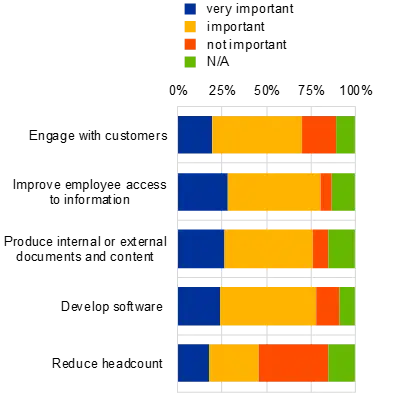
So yes, AI is not just a trend. It is a fundamental structural shift in the global economy.
Where AI Delivers the Biggest Gains
Interestingly, AI does not impact all types of work equally.
High-impact areas:
- Writing and documentation
- Data analysis and interpretation
- Coding and technical tasks
- Customer support automation
These are tasks where AI can process and structure information significantly faster than humans.
Lower-impact areas:
- Physical labor and mechanical work
- Tasks requiring deep human judgment or emotional interaction
- Complex decision-making with high real-world uncertainty
This explains why industries like tech and finance seem to benefit faster and more publicly than sectors like construction or healthcare operations.
Why AI Productivity Feels Inconsistent
If AI is so powerful, why do some professionals feel it barely helps them?
There are a few key reasons for this disconnect.
1. Not all tasks are AI-friendly
Some tasks are easy to abstract and automate, while others practically demand a human touch. For instance, generating the first draft of a report works wonderfully with AI. However, trying to lead a nuanced team meeting or resolve a sensitive client dispute using AI helps very little.
2. Human validation still matters
AI can generate vast amounts of output quickly, but you still need to carefully review its accuracy. You may need to repeatedly refine the results, and all necessary context and judgment still must come from humans. This extra validation step can significantly reduce the “perceived” productivity gain.
3. Adoption is still incredibly uneven
Many companies have not fully structurally integrated AI into their core workflows. Less than 12% of small firms in Europe use AI tools, compared to over 40% of very large firms. This massive adoption gap slows down the overall productivity impact we feel as a society.
The Real Shift: From Tasks to Systems
One of the most important insights regarding this technological boom is this: AI doesn’t just make tasks faster, it structurally changes how work itself is done.
Historically, major productivity jumps didn’t come from simply doing the exact same things faster. They derived from completely reorganizing how work is conceptualized.
Think about the past century:
- Electricity overhauled how factories operated.
- The internet revolutionized global communication.
- AI will fundamentally change daily workflows entirely.
For example, senior developers may spend far less time typing out repetitive boilerplate code, and vastly more time reviewing and architecting systems. Marketers may focus entirely on overarching brand strategy rather than the execution of basic copywriting. Teams will eventually rely more on AI-assisted decision-making frameworks. This systematic change is where the real, substantial long-term impact lies.
Potential Challenges to Watch
Even with its undeniably strong potential, AI is definitely not a perfect, solve-all solution.
Some ongoing challenges include:
- Over-reliance on AI tools without understanding the output
- Quality inconsistency and invisible hallucinations
- Data privacy, copyright, and security concerns
- Severe skill gaps in using AI interfaces effectively
There is also a significant risk of creating new bottlenecks. Tasks that AI cannot speed up, like final human sign-offs, may suddenly become the new limiting factor in previously smooth workflows.
Practical Takeaways
If you genuinely want to benefit from AI today, focus on this checklist:
- Use AI for the right tasks: Start exclusively with repetitive, time-consuming, or low-stakes work.
- Combine AI with human judgment: AI assists, but it absolutely does not replace critical thinking or moral judgment.
- Improve your workflow, not just your tools: The biggest gains come from reorganizing how you use AI, not just downloading an app and using it mindlessly.
- Keep learning: AI tools evolve incredibly fast. Staying updated and flexible is the best way to maintain a competitive advantage.
Conclusion
AI is undeniably changing productivity, but it is not doing so in a simple, flat, or uniform way.
It can dramatically speed up certain specialized tasks, improve brutal efficiency across multiple industries, and actively reshape how modern work is structured. At the exact same time, its real, lasting impact depends completely on how well we learn to adapt to and wield it.
The core takeaway is simple: AI is not just a tool designed to let you work faster. It is a catalyst meant to help you work smarter.
If you are curious about how to creatively apply these insights directly into real workflows, explore more articles in our Productivity category and keep building your professional edge step by step.
References